library(obisindicators)
#> Warning: replacing previous import 'h3::compact' by 'purrr::compact' when
#> loading 'obisindicators'
library(dplyr)
#>
#> Attaching package: 'dplyr'
#> The following objects are masked from 'package:stats':
#>
#>     filter, lag
#> The following objects are masked from 'package:base':
#>
#>     intersect, setdiff, setequal, union
library(sf)
#> Linking to GEOS 3.12.1, GDAL 3.8.4, PROJ 9.4.0; sf_use_s2() is TRUECreate function to make grid, calculate metrics, and plot maps for different resolution grid sizes
res_changes <- function(resolution = 2){
  hex_res <- 1  # hex_res 0 is too big to work, all others work
  hex <- obisindicators::make_hex_res(resolution)

  # === Then assign cell numbers to the occurrence data:
  occ <- occ %>%
    mutate(
      cell = h3::geo_to_h3(
        data.frame(decimalLatitude, decimalLongitude),
        res = resolution))
  idx <- calc_indicators(occ)

  grid <- hex %>%
    inner_join(
      idx,
      by = c("hexid" = "cell"))

  gmap_indicator(grid, "es", label = "ES(50)")
}
Different Resolutions
Details of H3 resolution differences can be found in the h3geo docs. Resolutions range from 0 (largest) to 15 (smallest).
Generally, resolution 0 is too big to be useful… or even functional, sometimes.
res_changes(0)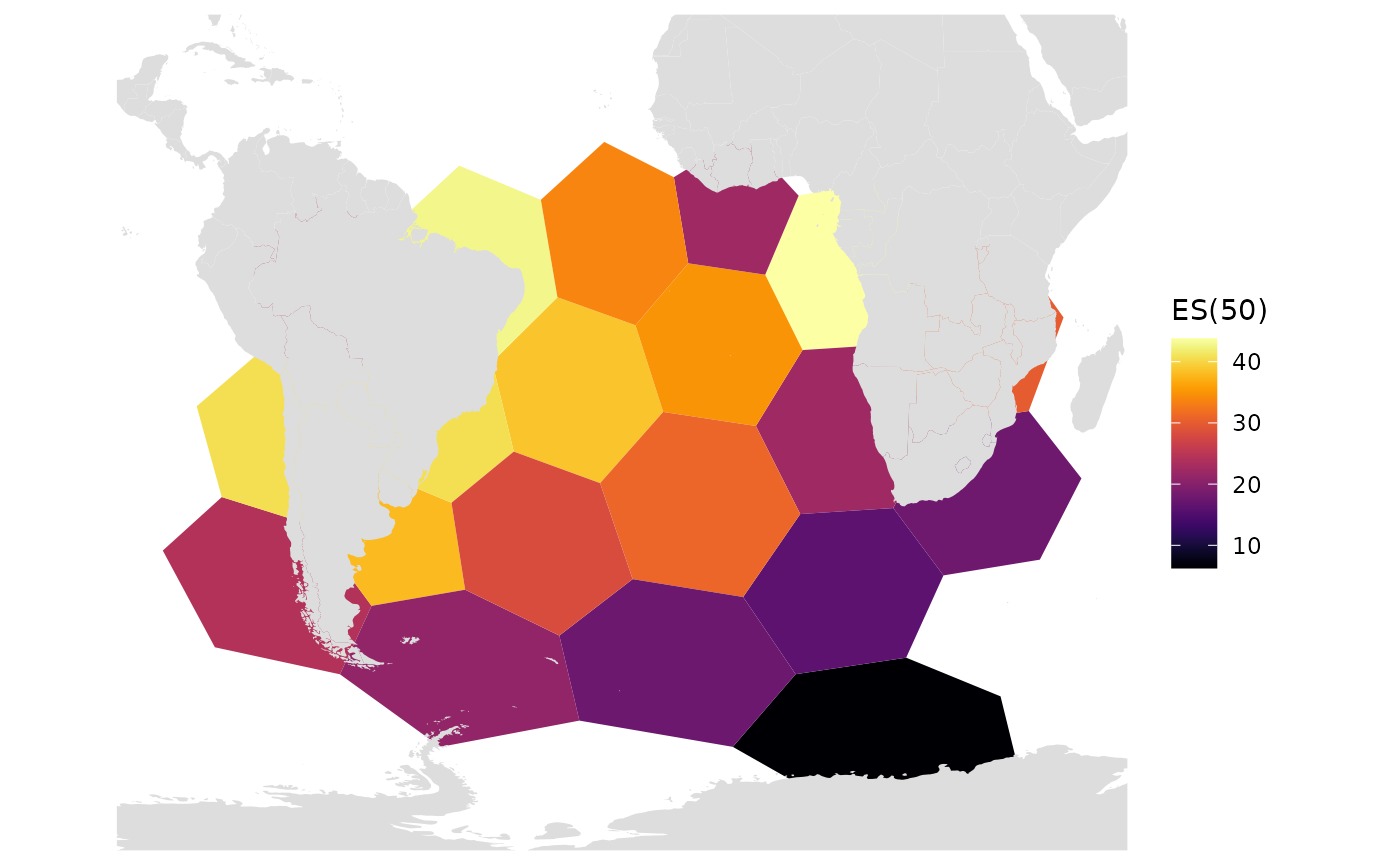
res_changes(1)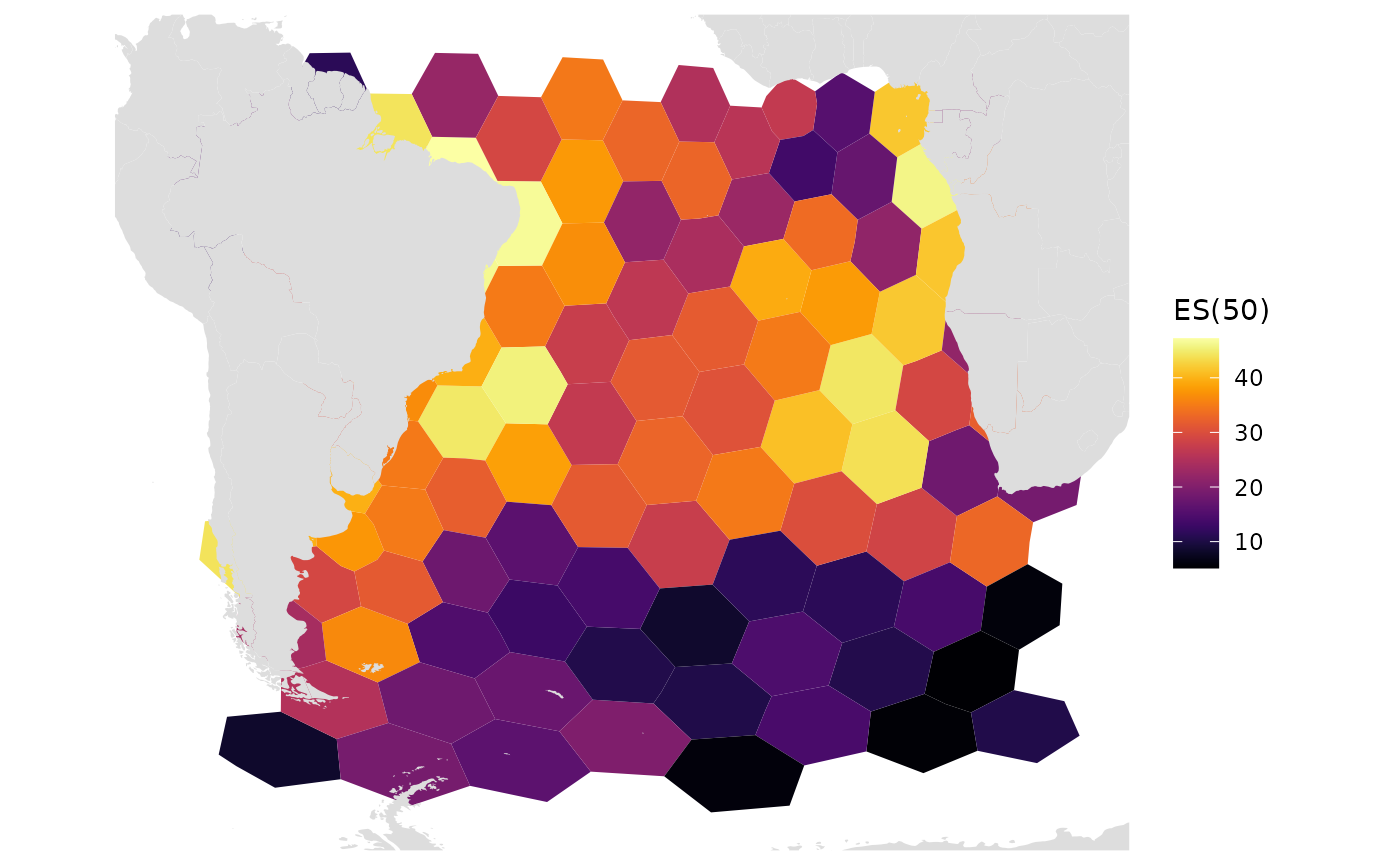
At this resolution the S Atlantic is completely covered, meaning that every hex had enough data to compute the ES(50) diversity metric. We can see some basic expected patterns such as: * higher diversity near to the coast * higher diversity near the equator
res_changes(2)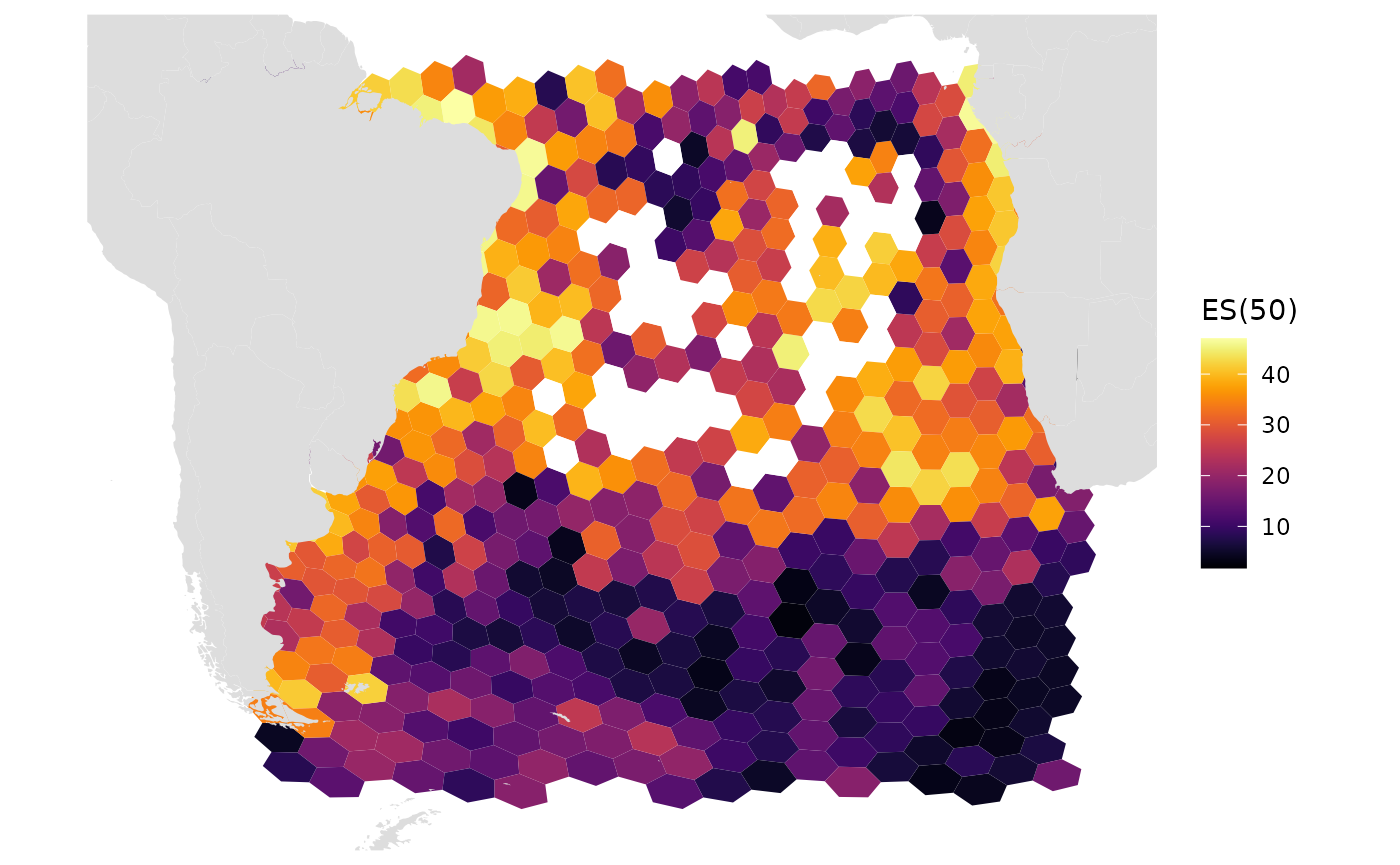
A this resolution we see gaps throughout the central South Atlantic. These hexagons did not have enough occurrence records to calculate the diversity metric.
res_changes(3)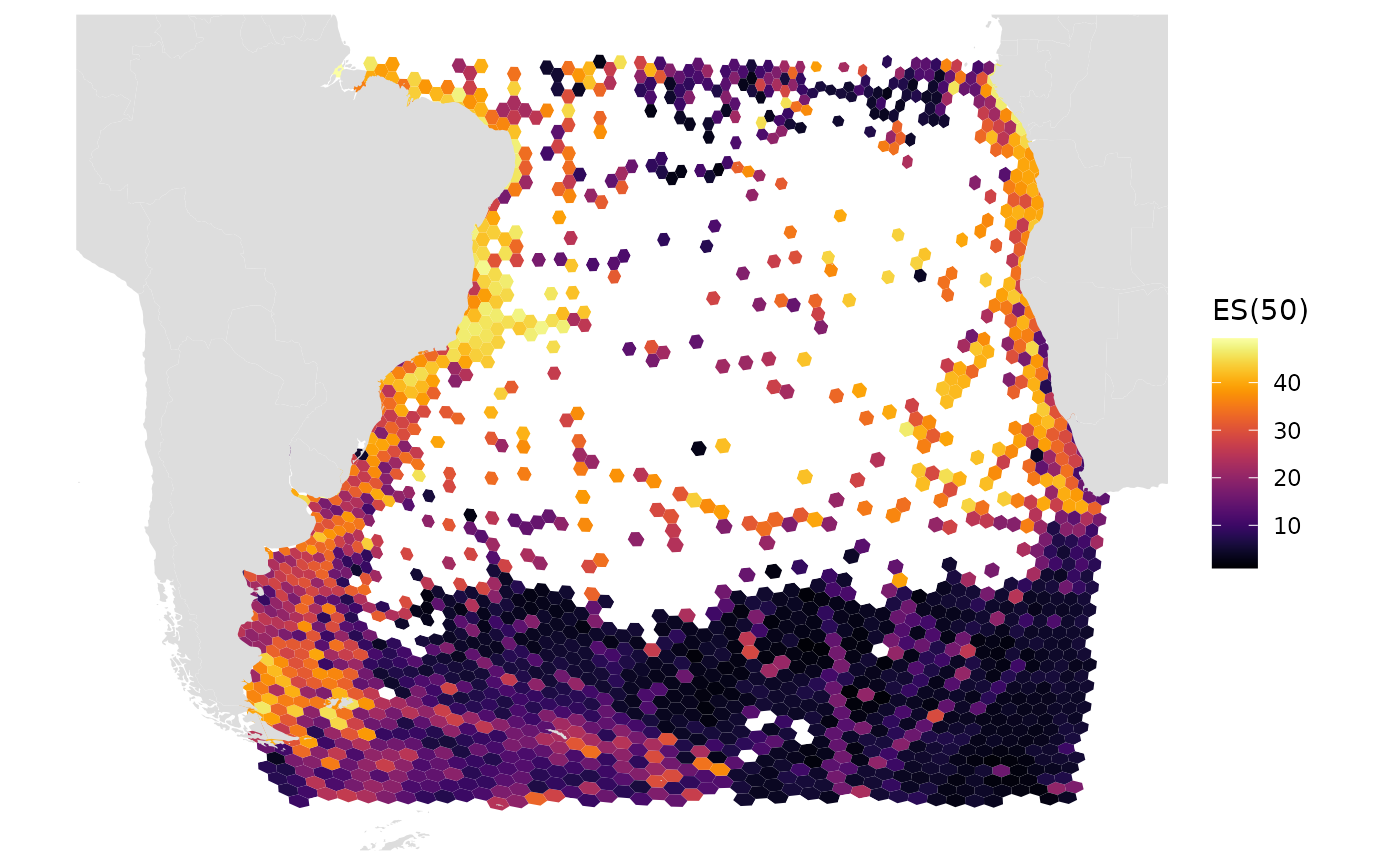 At this higher resolution, gaps dominate the map. Only places with
relatively dense surveying efforts have enough data to calculate the
diversity metric. Note how the relatively data-poor center has a
relatively stark boundary spanning from the southern tip of Africa
across. This boundary is visible in the diversity metric plots of lower
resolution in the form of a high-low diversity boundary. The appearance
of this abrupt high-low diversity boundary is likely an artifact of how
data-poor the central South Atlantic is. The ES50 diversity metric will
bias data-poor to more-diverse when there is extremely low amounts of
data. It should be noted, however, that this bias is much less
intense than the data-poor to less-diverse in other diversity
metrics.
At this higher resolution, gaps dominate the map. Only places with
relatively dense surveying efforts have enough data to calculate the
diversity metric. Note how the relatively data-poor center has a
relatively stark boundary spanning from the southern tip of Africa
across. This boundary is visible in the diversity metric plots of lower
resolution in the form of a high-low diversity boundary. The appearance
of this abrupt high-low diversity boundary is likely an artifact of how
data-poor the central South Atlantic is. The ES50 diversity metric will
bias data-poor to more-diverse when there is extremely low amounts of
data. It should be noted, however, that this bias is much less
intense than the data-poor to less-diverse in other diversity
metrics.