
The use of emerging autonomous technologies for ocean monitoring: insights and legal challenges
The use of emerging autonomous technologies for ocean monitoring: insights and legal challenges . Frontiers in Marine Science. doi:10.3389/fmars.2025.1561737
The critical role of biology Essential Ocean Variables (EOVs) in advancing our understanding of marine ecosystems underscores the need for sophisticated observation tools like Autonomous Underwater Vehicles (AUVs), Unmanned Aerial Vehicles (UAVs), Maritime Autonomous Vehicles (MAVs). However, the integration of these technologies in Marine Scientific Research (MSR) has surfaced significant legal and policy challenges. This study, informed by insights from forty-six experts across academia, oceanographic institutions, industry, and intergovernmental organizations, identifies six principal legal challenges relevant to the: operation and navigation of AUVs, data collection, security, environmental impact, animal tagging, and intellectual property rights. Effectively addressing these challenges requires a coordinated, multi-stakeholder approach among the scientific community, policymakers, and international bodies. States may promote an initiative to drive progress in ocean observation while laying the groundwork for advancements. To address the operational and regulatory complexities, States may coordinate collaboration through involvement of the Intergovernmental Oceanographic Commission (IOC), the International Maritime Organization (IMO), and the World Meteorological Organization (WMO), for example. Additionally, coordination with frameworks such as the BBNJ Agreement, UNCLOS, the Convention on Biological Diversity’s Kunming-Montreal Global Biodiversity Framework (CBD KM-GBF), and regional organizations like the Commission for the Conservation of Antarctic Marine Living Resources (CCAMLR) would ensure a comprehensive and inclusive approach.

Southeast US MBON
Southeastern United States, integrating fieldwork and satellite observations.
Learn more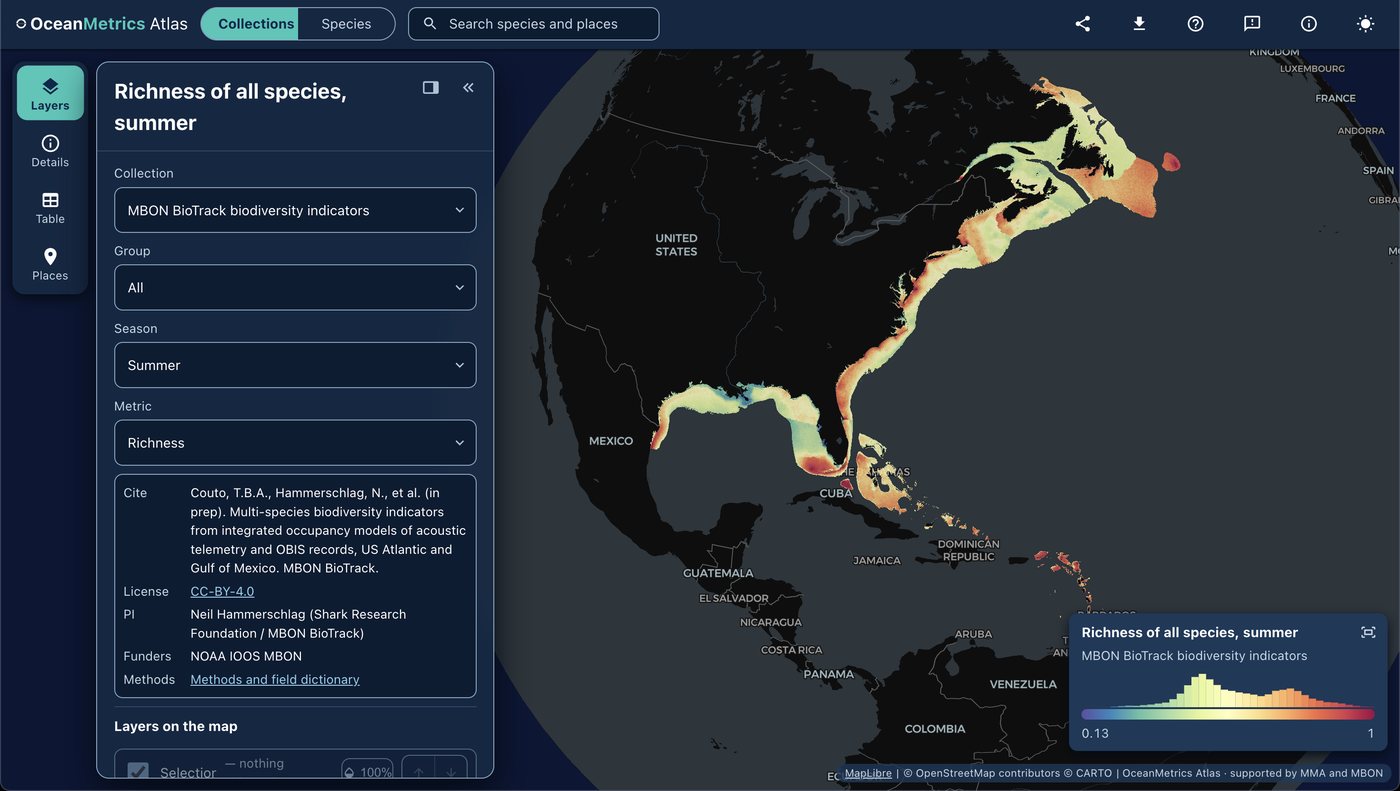
OceanMetrics Atlas
A browser map of species distribution and biodiversity model outputs, read from a STAC catalog. It opens on the AquaMaps EOV share and hosts the MBON BioTrack indicators (species richness and uncertainty from telemetry and OBIS).
Learn moreMarine megafauna select pelagic habitats in a dynamic ocean
Ben D’Antonio et al. · Landscape Ecology
Read paper
Tracking
Electronic tags on fish, turtles, marine mammals, and seabirds reveal how animals move through and use ocean habitat — essential for conservation planning and understanding climate responses.
Learn more
Indicators & Data Management
Raw observations become decision-relevant information through synthesis into Essential Ocean Variables, open data pipelines, and indicators that managers and policymakers can act on.
Learn more
ecoidx
R package implementing NOAA Integrated Ecosystem Assessment (IEA) indicator standards — workflows and visualizations for marine ecological indicators.
Learn more