
Capacity sharing to protect and restore ecosystems and biodiversity
Capacity sharing to protect and restore ecosystems and biodiversity . ICES Journal of Marine Science. doi:10.1093/icesjms/fsae187
Challenge 2 of the UN Ocean Decade focuses on protecting and restoring marine ecosystems and biodiversity as a fundamental requirement to achieve sustainable development. Addressing this challenge requires reliable and timely information on biodiversity and ecosystems. To achieve this, academic, government, and private groups should engage in a process of co-design that aims to facilitate decision-making at the local and national level, and agree on common and interoperable practices for the collection and curation of biology and ecosystem information. Implementing the flow of data to enable the management of human activities and sustainable development will require the sharing of capacity. An all-hands-on-deck effort will help us ensure a better future for ourselves. A positive step would be to identify the minimum essential ocean variables that can serve multiple relevant regional and international frameworks and to link and harmonize the required data and information flow (i.e., for frameworks including the Convention on Biological Diversity Kunming-Montreal Global Biodiversity Framework, the United Nations Framework Convention on Climate Change Paris Agreement, the Biodiversity Beyond National Jurisdiction Agreement, the International Seabed Authority, the Convention on the Conservation of Antarctic Marine Living Resources, the Intergovernmental Science-Policy Platform on Biodiversity and Ecosystem Services, and deep and national ocean fisheries policies). A key strategy is to support and build on existing local and national networks for biodiversity observation. With this information, local communities and nations can better understand and manage how they use marine life and also report on progress toward Sustainable Development Goals.
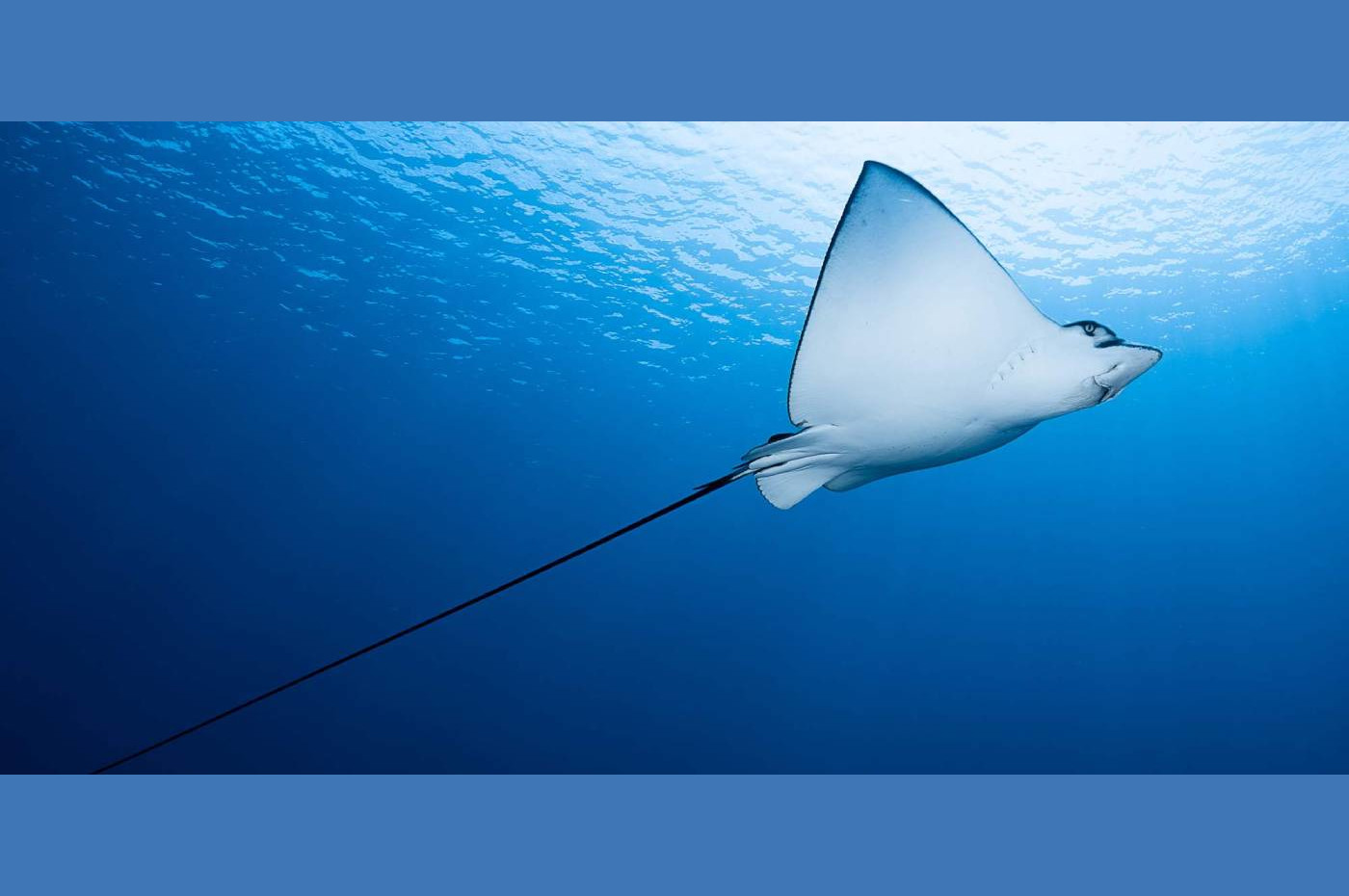
US MBON
The U.S. partnership integrating biology and ecosystem surveys with remote sensing and molecular (eDNA) methods across regional MBONs.
Learn morePole to Pole Americas
A network of networks spanning the Americas.
Learn more
Indicators & Data Management
Raw observations become decision-relevant information through synthesis into Essential Ocean Variables, open data pipelines, and indicators that managers and policymakers can act on.
Learn more
ecoidx
R package implementing NOAA Integrated Ecosystem Assessment (IEA) indicator standards — workflows and visualizations for marine ecological indicators.
Learn more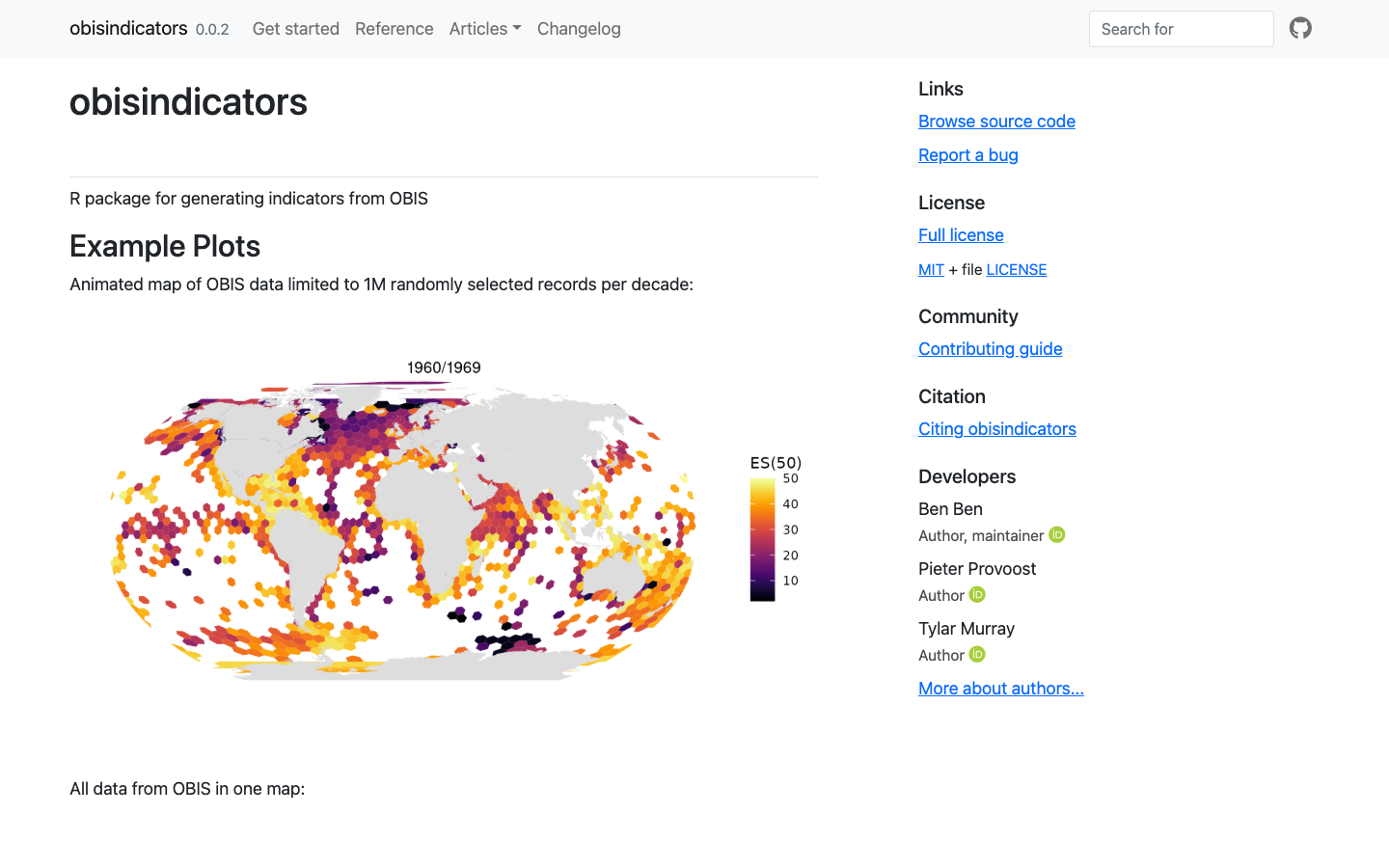
obisindicators
R package for generating biodiversity indicators — including ES(50) estimated species richness — from OBIS occurrence data.
Learn more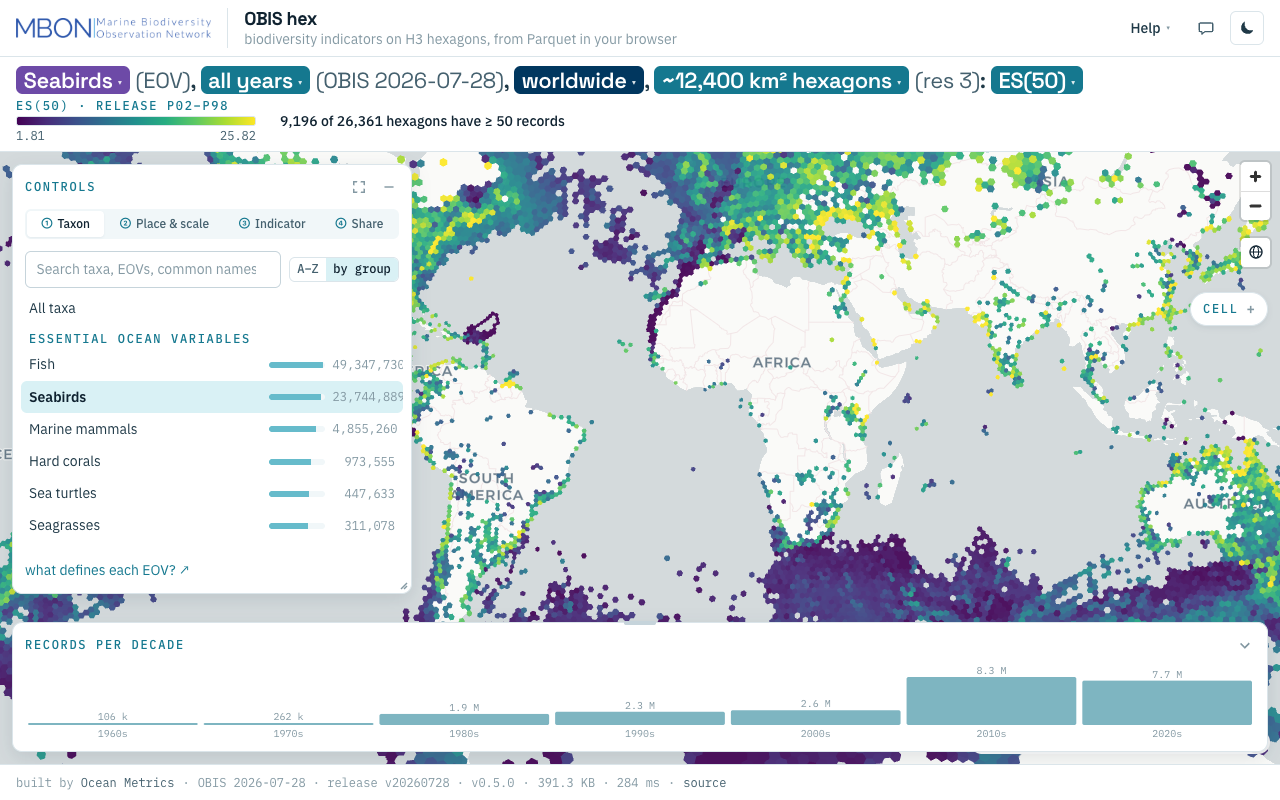
OBIS hex
Biodiversity indicators from every OBIS record on H3 hexagons, from ES(50) to records per decade, computed from Parquet in your browser with no server. The URL is the view.
Learn more