
Climate‐Driven Shift of Immature Albacore: Potential Habitat Alterations in the Indian Ocean
Climate‐Driven Shift of Immature Albacore: Potential Habitat Alterations in the Indian Ocean . Fisheries Oceanography. doi:10.1111/fog.70011
Climate change is causing significant changes in maritime habitats, altering the distribution of marine organisms and potentially leading to poleward migration of species, impacting fishing operations and coastal communities' subsistence methods. The present study analyzed the distribution of the Indian Ocean immature albacore tuna ( Thunnus alalunga ) by using an ensemble modeling approach and considering three representative concentration pathway (RCP) scenarios (2.6, 4.5 and 8.5) to assess the implications of predicted climate change. Three species distribution models (generalized additive modeling, boosted regression tree, and random forest) incorporating various oceanographic parameters were used as inputs to create an ensemble model that replicated the immature albacore distribution. The study period revealed that the distribution of immature albacore tuna was primarily concentrated between 28°S and 34°S in the Indian Ocean. The findings indicated a substantial disparity in the distribution of immature albacore tuna by the year 2100, with RCP 8.5 showing a notable contrast to RCP 2.6. The projected distribution range under RCP 8.5 is expected to significantly change by 2100, with an estimated range of 38°S–41°S, compared to 30°S–34°S under RCP 2.6. By integrating these outcomes into managerial strategies, decision‐makers can make informed decisions that not only protect the other fisheries of the Indian Ocean but also safeguard the livelihoods of the people who rely on them in the face of changing climatic conditions.

Southeast US MBON
Southeastern United States, integrating fieldwork and satellite observations.
Learn more
Remote Sensing
Satellites and aerial sensors resolve ocean color, temperature, and habitat extent across millions of square kilometers — scales no ship survey can match.
Learn more
extractr
R package providing a common interface to extract and summarize gridded environmental data (ERDDAP, DataONE, and more) over a place.
Learn more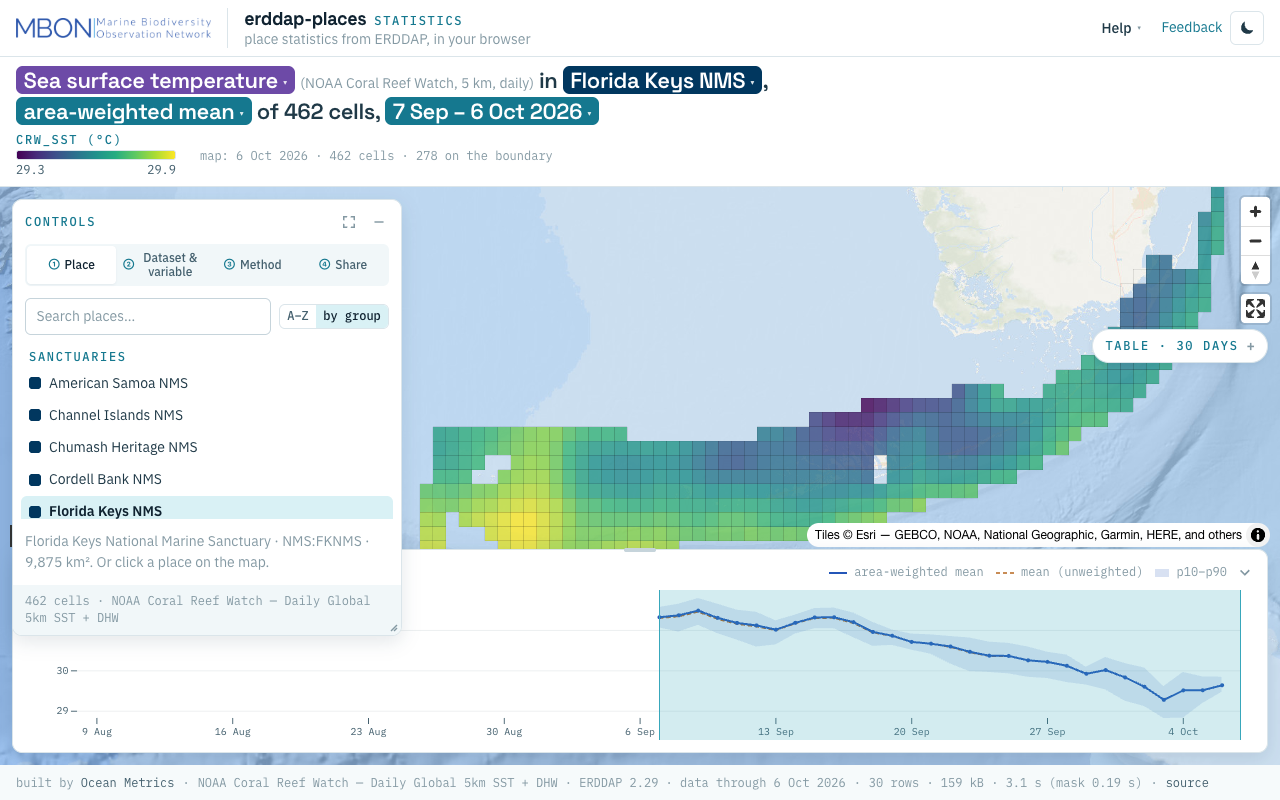
erddap-places
Place statistics from ERDDAP gridded and tabular data for sanctuaries and other marine places, computed in your browser, plus a Then vs Now lens for sanctuary sea surface temperature. The URL is the view.
Learn more
AquaMaps Downscaled
Downscaled AquaMaps modeled species distributions for finer-resolution marine biodiversity mapping.
Learn more
MarineSDMs
Materials and code for building marine species distribution models (SDMs) from open occurrence and environmental data.
Learn more