
GOOS Essential Ocean Variables: the backbone of a sustained and evolving global ocean observing system
GOOS Essential Ocean Variables: the backbone of a sustained and evolving global ocean observing system . Frontiers in Marine Science. doi:10.3389/fmars.2026.1737002
The need for ocean information has never been greater. From climate change to food security and extreme events, we need to understand the role of the ocean and better predict change and impact. This is only possible with the sustained collection of a key set of ocean observations. The Global Ocean Observing System (GOOS) coordinates international efforts to collect these Essential Ocean Variables (EOVs), which span physics, biogeochemistry, biology and ecosystem realms. Guided by three expert panels, these EOVs are used to define the needs and design of a sustained, fit for purpose global ocean observing system, aimed at maximizing investments in observing infrastructure. As the GOOS EOVs are increasingly used, it has become important to discuss and refine the understanding of this framework, to ensure that the right balance is struck between their essential nature and the need to expand to new domains and integrate with key global policies. In this paper we provide a description of the EOV framework, discuss some of the challenges in implementing it, and identify a set of recommendations for GOOS and the ocean observing community to take forward. These recommendations include increasing the transparency of the EOV adoption process, and the need to periodically assess the EOVs in consultation with observing communities and with the entities managing other global essential variable frameworks in cross cutting realms such as climate and biodiversity. This will contribute to building a useful and responsive global ocean observing system that delivers the observations required to meet societal needs.

Southeast US MBON
Southeastern United States, integrating fieldwork and satellite observations.
Learn moreIndicators
Synthesizing raw observations into Essential Biodiversity Variables and Essential Ocean Variables for policy-relevant reporting.
Learn more
Indicators & Data Management
Raw observations become decision-relevant information through synthesis into Essential Ocean Variables, open data pipelines, and indicators that managers and policymakers can act on.
Learn more
ecoidx
R package implementing NOAA Integrated Ecosystem Assessment (IEA) indicator standards — workflows and visualizations for marine ecological indicators.
Learn more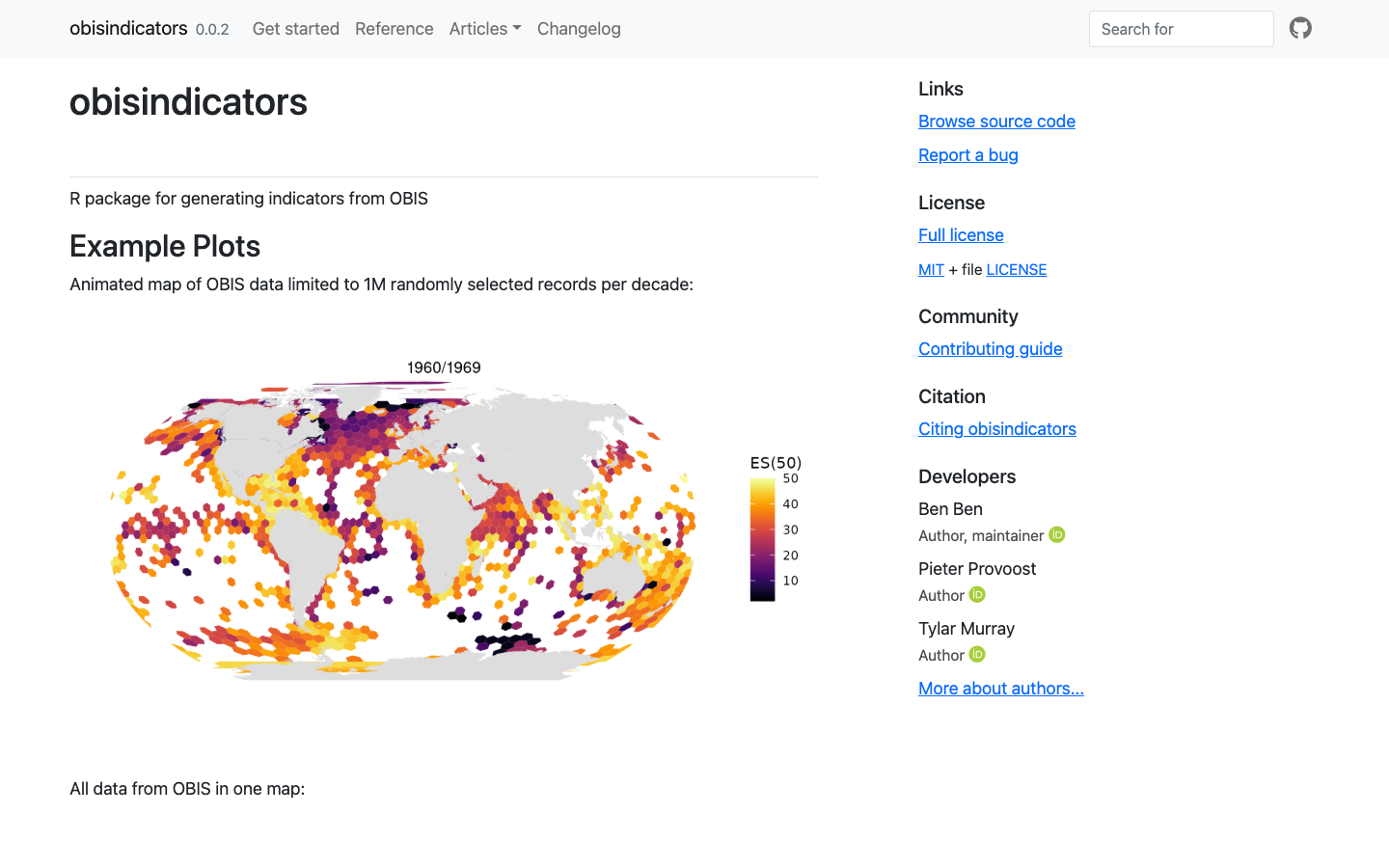
obisindicators
R package for generating biodiversity indicators — including ES(50) estimated species richness — from OBIS occurrence data.
Learn more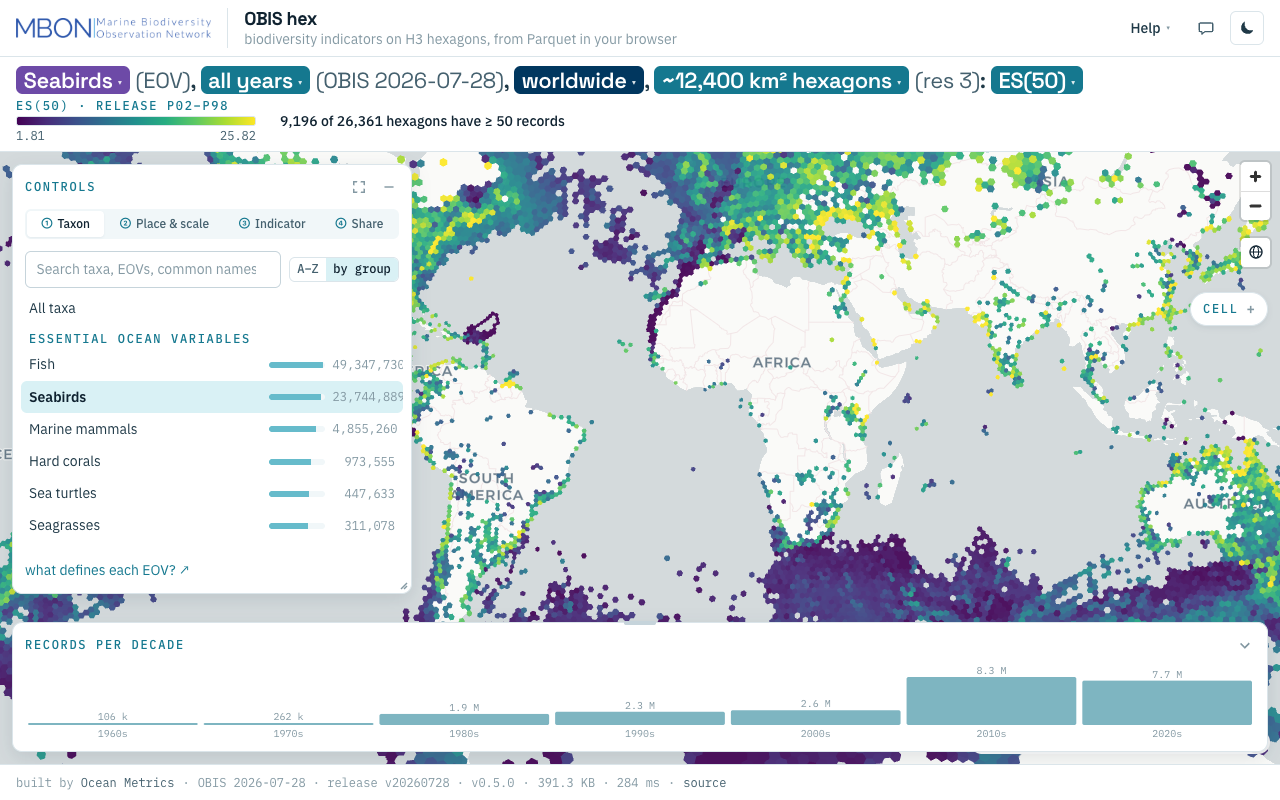
OBIS hex
Biodiversity indicators from every OBIS record on H3 hexagons, from ES(50) to records per decade, computed from Parquet in your browser with no server. The URL is the view.
Learn more