
From Data to Decision: Leveraging Essential Variables in Standardizing Biodiversity and Ecosystem Services Monitoring and Reporting
From Data to Decision: Leveraging Essential Variables in Standardizing Biodiversity and Ecosystem Services Monitoring and Reporting . Conservation Letters. doi:10.1111/con4.70042
Fragmented systems for monitoring and assessing biodiversity and ecosystem services limit the ability to track progress at local and national scales in international multilateral environmental agreements (MEAs). This greatly challenges coordinated actions to meet agreed‐upon global commitments. Filling this gap requires integrated and concerted design of data‐to‐decision workflows. The Essential Biodiversity Variables (EBVs) and Essential Ecosystem Service Variables (EESVs) are tools that can coordinate structured and consistent monitoring, generate harmonized and scalable data products, and facilitate reporting that is useful for multiple purposes. Specifically, EBV/EESV data products are intended to synthesize information to serve the needs of the Global Biodiversity Framework (GBF), the System of Environmental‐Economic Accounts Ecosystem Accounting (SEEA‐EA), and assessments of the Intergovernmental Science‐Policy Platform on Biodiversity and Ecosystem Services (IPBES) while also informing regional, national, and sub‐national conservation policy. This integrative approach works if local data collection is designed to be interoperable, and it is fundamental to improve models, forecasts, and indicators required in key policy and decision processes. Through application cases, we demonstrate the use of EBVs and EESVs in national assessments and scenario analyses for strategic policy and spatial planning with scalable and repeatable workflows from primary data to indicators for decision support.

Southeast US MBON
Southeastern United States, integrating fieldwork and satellite observations.
Learn moreIndicators
Synthesizing raw observations into Essential Biodiversity Variables and Essential Ocean Variables for policy-relevant reporting.
Learn more
Indicators & Data Management
Raw observations become decision-relevant information through synthesis into Essential Ocean Variables, open data pipelines, and indicators that managers and policymakers can act on.
Learn more
ecoidx
R package implementing NOAA Integrated Ecosystem Assessment (IEA) indicator standards — workflows and visualizations for marine ecological indicators.
Learn more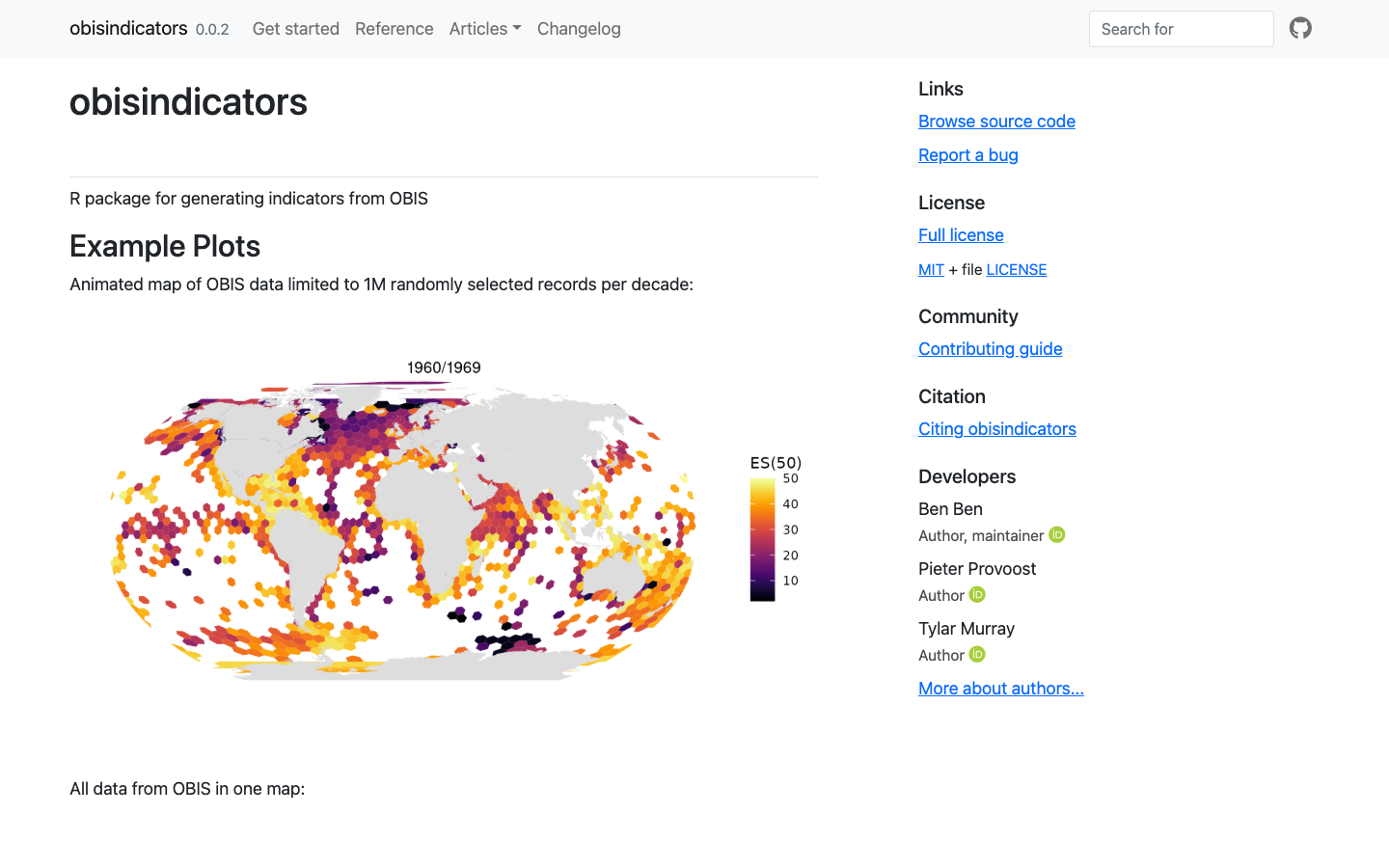
obisindicators
R package for generating biodiversity indicators — including ES(50) estimated species richness — from OBIS occurrence data.
Learn more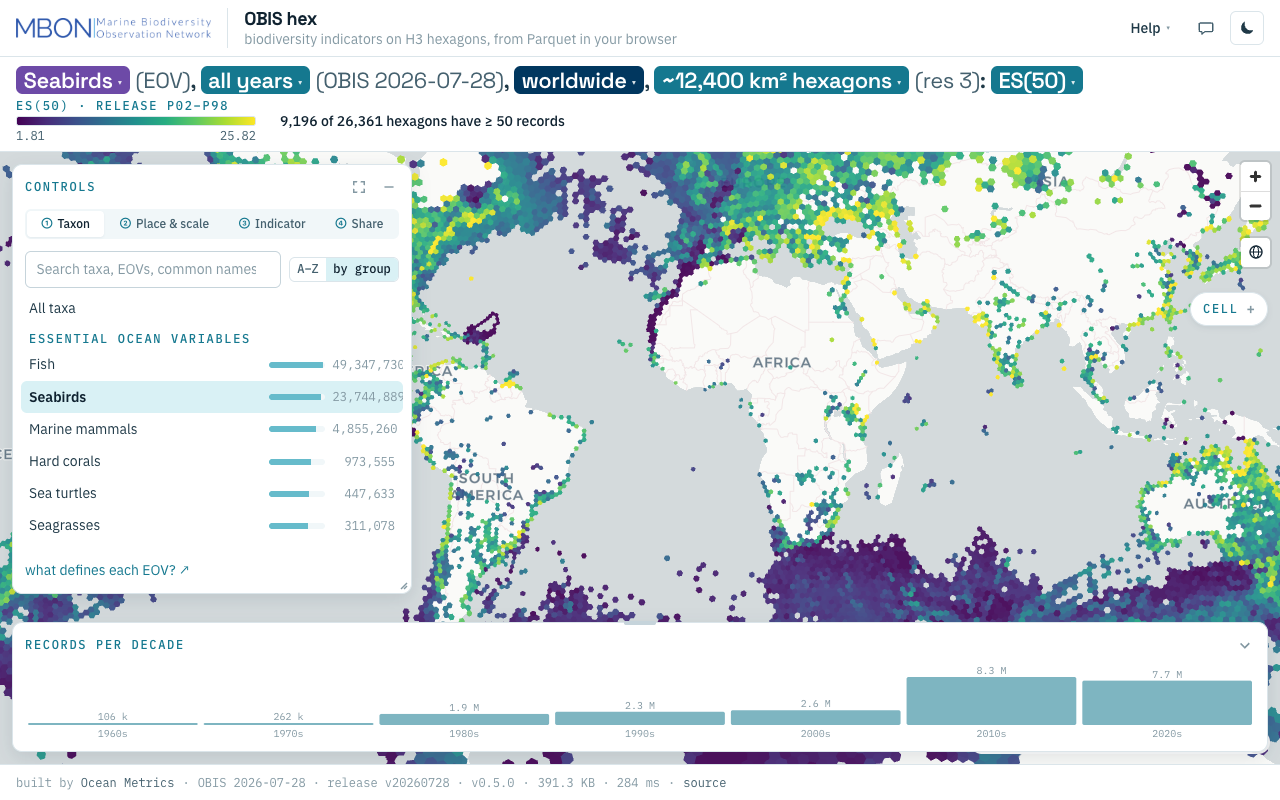
OBIS hex
Biodiversity indicators from every OBIS record on H3 hexagons, from ES(50) to records per decade, computed from Parquet in your browser with no server. The URL is the view.
Learn more