






By Rebecca Trinh February 26, 2026
Over 85 years ago, author John Steinbeck and marine biologist Ed Ricketts set out for the Sea of Cortez as friends chasing curiosity, connection, and adventure. Their book Sea of Cortez became both a landmark biodiversity record and a meditation on humanity’s relationship with nature. Today, as climate change and coastal development reshape the ocean, their tidepool observations offer a rare window into long-term ecological change—and their reflections on the human spirit feel more relevant than ever.
In 2025, the Green Flash Conservation Science team of early-career scientists from the U.S. and Mexico was awarded seed-funding from the nonprofit Sea Education Association to undertake the ambitious plan of retracing Steinbeck and Ricketts’ 1940 intertidal biodiversity expedition in the Sea of Cortez to understand how biodiversity has changed since they last set foot on the shores of Baja. Led by Dr. Rebecca Trinh, the Green Flash team began planning for a 2026 Sea of Cortez expedition and worked hard to establish connections with respected environmental science groups to enhance the impact of their Mareas en movimiento (Shifting Tides) Sea of Cortez resurvey. This included partnering with Blue Marble Space Institute of Science as their fiscal sponsor and recently joining the MBON Pole-to-Pole initiative.
Joining the Marine Biodiversity Observation Network (MBON) Pole-to-Pole initiative transforms their 2026 Sea of Cortez scientific expedition into something bigger. Dr. Trinh shared that “being part of MBON connects our small, grassroots expedition to a global network of scientists, communities, and observing systems working together to understand biodiversity change across the globe. That affiliation brings credibility and access to shared expertise, standardized methods, and a culture of open, collaborative science”. Engaging with the MBON Pole-to-Pole network provides an opportunity to contribute observations and examine changes in the rocky shores of the Sea of Cortez in the context of the broader region, from Canada through Patagonia.
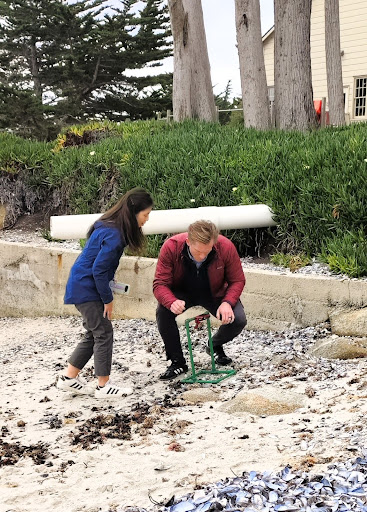
For their 2026 Sea of Cortez expedition, the Green Flash team will be implementing MBON Pole-to-Pole’s rocky intertidal photo-quadrat protocol used across the Pole-to-Pole network, in conjunction with traditional intertidal species surveys, at 12 of Steinbeck and Ricketts’ original intertidal sites. The team has been working with MBON Pole-to-Pole collaborators in Argentina to construct their photo-quadrats using MBON’s schematic and protocol, and has been working with collaborators at NOAA AOML Omics to implement their environmental DNA (eDNA) sample collection and processing protocols. This allows the new Sea of Cortez intertidal data to be directly comparable with observations from other regions, helping reveal large-scale patterns in coastal biodiversity, climate stress, and ecosystem change. The team shares that “the intertidal zone is more than a place of study—it is a mirror of the planet’s health—and it is an honor to work with MBON Pole-to-Pole to better understand and safeguard these fragile, yet resilient habitats”.
Figure 1: Green Flash Conservation Science team members Dr. Rebecca Trinh and Dr. Maxwell Cunningham testing the photo-quadrat they built using MBON Pole-to-Pole’s protocol.
Dr. Trinh states that “MBON allows us to bring Steinbeck and Ricketts’ historic survey into the modern era and a new generation, linking their careful natural history with today’s molecular tools and long-term observing frameworks. Our 2026 biodiversity data will be compared directly to the data collected by Steinbeck and Ricketts to understand how the biodiversity of these important intertidal ecosystems has changed since 1940, and its impacts on local communities”.
In 1940, Steinbeck and Ricketts described the Sea of Cortez intertidal ecosystem as “ferocious with life.” Since then, coastal development, pollution, warming waters, and overharvesting have reshaped these ecosystems, yet the intertidal region remains understudied. The intertidal ecosystem is the first indicator of marine ecosystem health, as it sits at the interface between land and sea Local communities have reported declines in overall biodiversity and a northward shift of warm-water species.. The Green Flash team is resurveying biodiversity at Steinbeck and Ricketts original sites to measure 86 years of biodiversity change, pairing science and storytelling to strengthen conservation and reconnect people to this fragile coast and beyond.
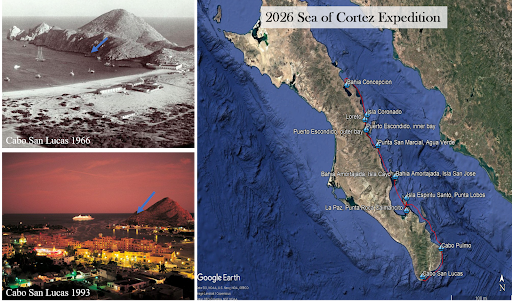
Figure 2: Figure 2: Photographs illustrating how Cabo San Lucas has drastically changed over the years. The top left photos shows Cabo San Lucas in 1966, 26 years after Steinbeck and Ricketts studied intertidal biodiversity at the location marked by the blue arrow. The bottom left photo shows the same location in 1993. The Green Flash team will be revisiting this exact site and 11 other Steinbeck and Ricketts sites in 2026 as part of their Sea of Cortez biodiversity expedition, as shown in the map on the left.
MBON also strengthens their work beyond data collection. The network’s commitment to education, inclusion, and community engagement aligns deeply with the 2026 Sea of Cortez project. The Green Flash team is working with local Baja partners to build long-term monitoring sites, train students and community scientists, and share results through bilingual storytelling. By following open data practices, their observations will move more quickly from field notebooks to shared knowledge that can inform research, management, and conservation.
“Most of all, being part of MBON reminds us that we are not working in isolation. We are one node in a living, global effort to understand life in the ocean—and to make that knowledge useful for people and ecosystems alike. Bringing Baja’s intertidal diversity into the MBON network ensures that these tidepools are now part of a shared scientific story and network of global biodiversity science” concludes Dr. Trinh, reflecting on the value of joining the MBON Pole-to-Pole network.
Rebecca Trinh
Mississippi State University (MSU)
Northern Gulf Institute (NGI)
National Oceanic and Atmospheric Administration (NOAA)
Atlantic Oceanographic and Meteorological Laboratory (AOML)