


















By Emily Davenport January 15, 2026
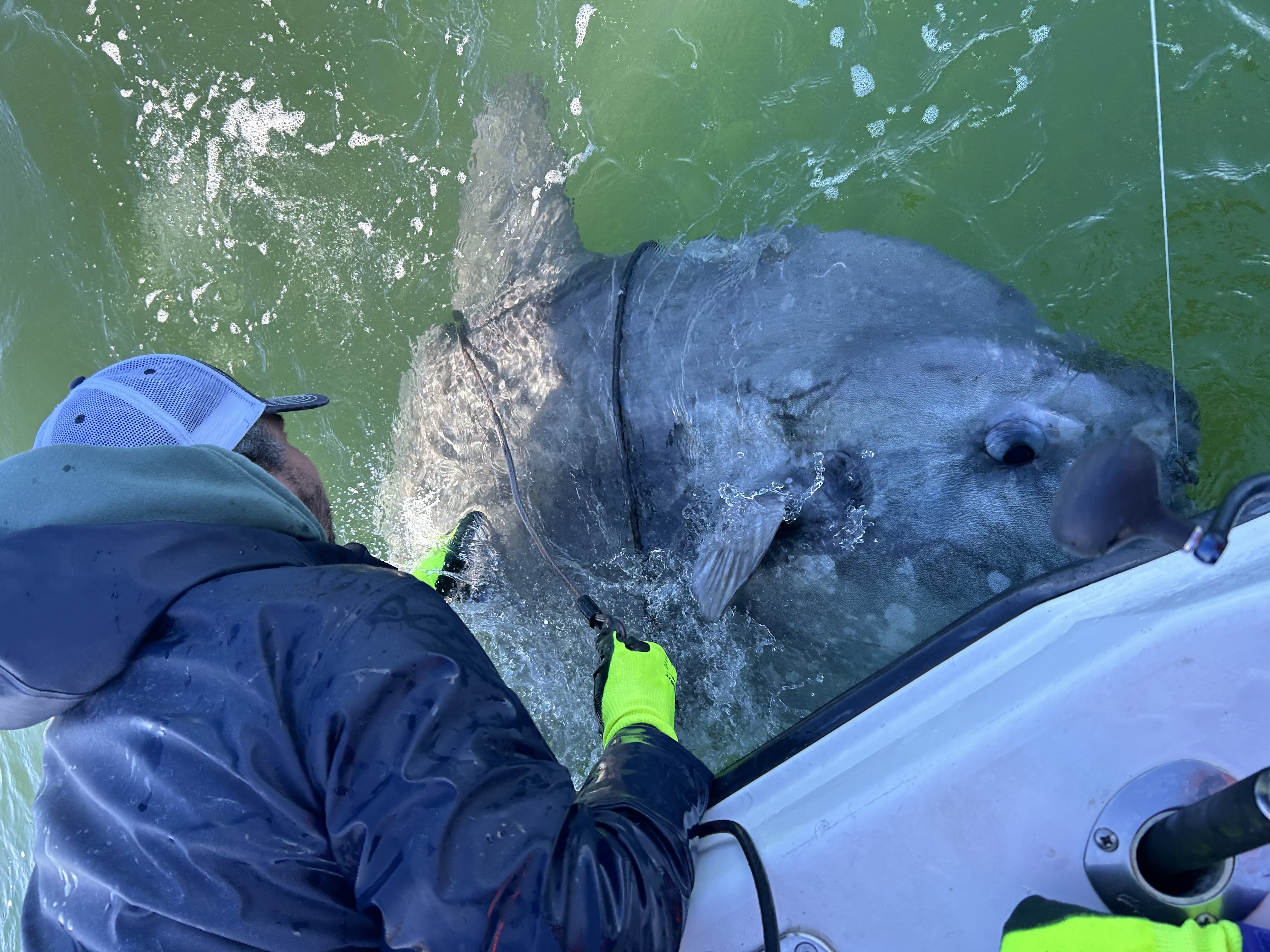
By tracking marine species like the ocean sunfish (Mola mola), BioTrack -- a project of the Marine Biodiversity Observation Network (MBON) -- is uncovering key patterns in biodiversity and making marine animal movement data accessible to stakeholders. Photo Credit: Dr. Austin Gallagher – Beneath The Waves
–
Background
The Atlantic is home to a wide diversity of marine species, many of which share habitats impacted by human activities. Identifying areas of the ocean that are important to many different species, and how these hotspots intersect with human activities, is crucial for effective conservation, sustainable management, and overall ocean planning.
That’s the mission of BioTrack, a collaborative project led by Dr. Neil Hammerschlag. Supported by the MBON and the Animal Telemetry Network (ATN), BioTrack is combining satellite and acoustic tracking of marine animals with environmental data and modeling to identify, monitor, and predict changes in marine biodiversity hotspots and use this information to provide practical data products for decision-makers. This data will also be made publicly accessible through an interactive portal, supporting fisheries management, spatial planning, and marine conservation efforts. The project is currently regionally focused on the waters of the United States’ North Atlantic.
“The BioTrack project is highly collaborative, with researchers tagging all different types of species, from tiny river herring to massive blue whales, and everything in between,” said Hammerschlag, Executive Director of the Shark Research Foundation. “Our ultimate goal is to use the resulting information from this effort to help guide sustainable use of ocean resources while preserving biodiversity hotspots.”
For BioTrack’s first tagging effort in the North Atlantic, project collaborators tagged one of the ocean’s most unusual and understudied fish species: the ocean sunfish (Mola mola).
Why Ocean Sunfish Are Ideal for Tracking Biodiversity
The ocean sunfish is a large fish that can weigh upwards of 1,000 pounds and span 10 feet from fin to fin. Despite their size, these fish are not well understood, with little published research available on them. They eat a lot of gelatinous creatures like jellyfish, spend a lot of time on or near the ocean surface, but also make deep dives into the twilight zone (200-1000 meters beneath the ocean’s surface), to forage.
For BioTrack collaborator Dr. Austin Gallagher (founder of the marine research organization Beneath The Waves), these qualities make ocean sunfish ideal candidates for BioTrack. “They are true ocean giants - mobile, visible species that use a variety of habitats,” Gallagher explains. “Tracking them helps us understand not only their movements but also the broader biodiversity hotspots where multiple species converge.”
The species is also fascinating biologically. Ocean sunfish are believed to be the most fecund vertebrates on Earth, producing upwards of 300 million eggs per year. They frequently spend time at the surface on calm days, lying flat on their sides, sunning themselves on the surface. Researchers think this behavior helps warm their eyes and brain, supporting the deep dives they make in search of prey.
How Do You Tag an Ocean Sunfish?
Tagging these giant fish is no small feat. They’re indifferent to being baited, due to their preference for jellyfish, and are covered in incredibly tough, sandpaper-like skin. Their large dorsal fin is powerful enough to launch them into the air, and with their massive size, they can easily overpower a tagging crew.
“It was way harder than I expected,” Gallagher said with a laugh.
Working with anglers for the last several years, the team pioneered a method that relied on patience, sharp eyes, angling prowess, and a bit of creativity. Spotters would locate the fish from a boat or even a small plane, looking for flat bodies basking in the sunlight. Then the team secured the fish with a line and lasso, allowing it to be brought to the side of the boat for sampling to begin and tags to be attached.
“Once they’re alongside the boat, they are actually quite calm,” Gallagher said. “They’re huge and powerful, but docile when handled carefully.”
The tags themselves range from pop-off archival tags that record vertical movements, to real-time satellite tags that track long-distance travel, to short-duration biologgers equipped with multiple sensors. Depending on the tag type, they can transmit data for months or up to a full year. The ocean sunfish tagged in September 2025 were outfitted with satellite tags supported by BioTrack, and their real-time tracks can be viewed in the map below.
Live map depicting the satellite tracks or three ocean sunfish tagged as part of the BioTrack project. The map updates with the tracks in near-real time, revealing new insights into habitat use of these species.
Because ocean sunfish have such large, flat bodies, the team had flexibility in where to place the tags. Positioning them high on the body—near the dorsal area but out of the animal’s way—allows for strong satellite transmission while reducing the likelihood of interference or harm.
Early Insights from Ocean Sunfish Tracking
Even in the early stages, the data from tagged sunfish are providing valuable insights. Most individuals remain close to the coast but travel long distances, from Maine to North Carolina, in a short period of time. The team has also observed sunfish gathering together near offshore canyons, suggesting they may be taking advantage of upwelling zones for foraging.
“These fish are much more dynamic than we expected,” Gallagher says. “Tracking them helps reveal areas of potential biodiversity that were previously hidden, as the sunfish show intentional selection of offshore seamounts and follow oceanic currents closely.”
As the dataset grows, these ocean sunfish movements will become part of a larger, integrated picture that BioTrack is building for resource managers. These insights will support tools that can forecast species presence, highlight ecologically important corridors, and guide decisions ranging from seasonal management to long-term spatial planning.
The Future of BioTrack and MBON
The ocean sunfish tagging is only the beginning. BioTrack aims to integrate newly acquired and existing historical tracking data from a variety of marine species — including sharks, sea turtles, seabirds, and marine mammals — to build a comprehensive picture of biodiversity hotspots. While the project is still in its data collection phase, BioTrack welcomes any researcher with existing acoustic or satellite tracking data to participate in the project.
All data products will eventually become publicly available, where managers, researchers, and the public can explore biodiversity patterns and their overlap with marine protected areas and human-use areas.
–
This work was supported by the U.S. Marine Biodiversity Observation Network (MBON) co-organized by NOAA, NASA, BOEM, and ONR through the National Oceanographic Partnership Program (NOPP).