




December 10, 2025
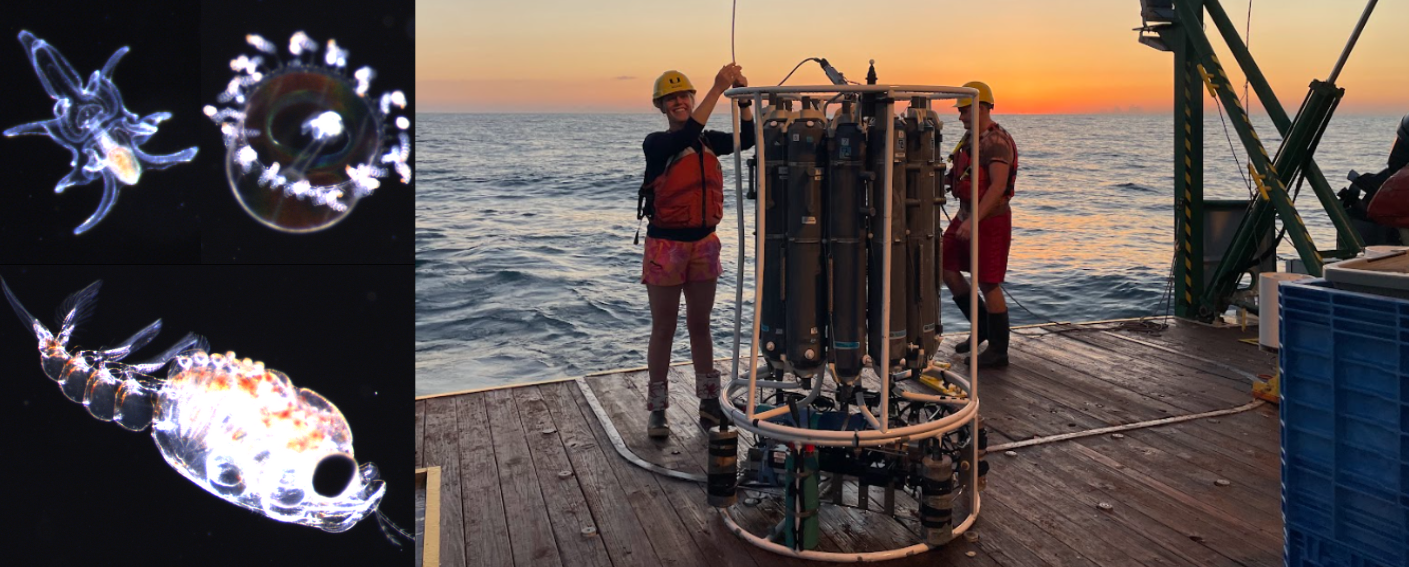
Pictured: Students operate a Conductivity, Temperature, and Depth (CTD) Rosette with an underwater microscope attached to capture photos of plankton. Far left top: starfish larva, left top: jellyfish larva, bottom left: crab, shrimp, or lobster larva.
Dr. Enrique Montes is working to understand how plankton respond to changes in the ocean by capturing high resolution imagery with advanced technology. This work is funded by the Marine Biodiversity Observation Network (MBON) to use novel techniques like the Continuous Particle Imaging and Classification System (CPICS).
Capturing High-Resolution Plankton Images
The ocean isn’t just salty.
Seawater is filled with tiny organisms called plankton that are invisible to the naked eye and the foundation of all life in the ocean.
Dr. Enrique Montes, Associate Scientist at the Cooperative Institute for Marine and Atmospheric Studies (CIMAS) of the University of Miami, is working with NOAA’s Atlantic Oceanographic and Meteorological Laboratory (AOML) to understand how these microscopic life forms respond to changes in the ocean by capturing high-resolution imagery with advanced technology that seemed like science fiction mere years ago.
Dr. Montes is documenting the abundance of a wide range of plankton species present in South Florida waters with a Continuous Particle Imaging and Classification System (CPICS), an underwater microscope that captures photos of plankton in their natural habitat.
The CPICS is attached to a Conductivity, Temperature, and Depth (CTD) Rosette, a system that collects water samples from different depth levels in the ocean.
CTD Rosettes are a staple technology on research cruises conducted off the coast of South Florida by Dr. Montes and his team.
The CPICS typically captures over 100,000 images per research cruise that can be analyzed while still on the boat and classified later in the lab using computer vision algorithms.
This microscope can photograph organisms as small as 40 microns, which is smaller than a grain of salt, and up to 12 mm, producing colorful images capable of identification.
Informing Biodiversity Assessments
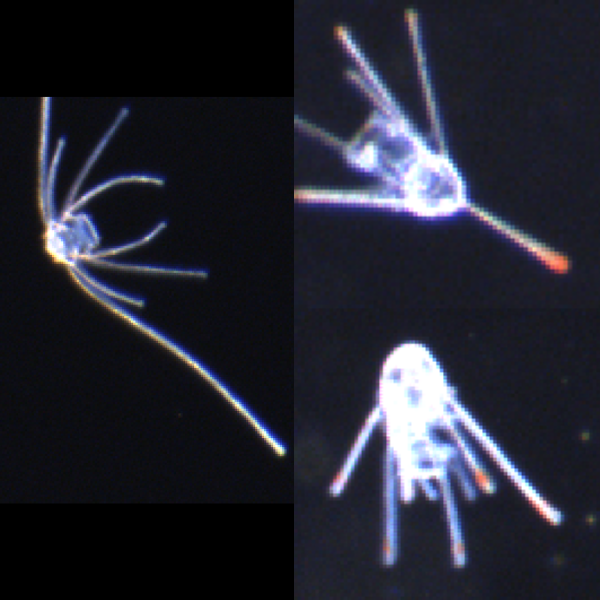
Pictured: Larval forms of sea star and sea urchin.
While this information is groundbreaking and interesting to marine biologists, plankton population observations can also inform biodiversity assessments.
Representing the bottom of the food chain, plankton composition and numbers can paint a picture of what the rest of the marine life in the area looks like.
For example, many sea creatures like starfish have a life cycle stage as plankton.
If the CPICS captures images of a large number of sea star larvae, that can be indicative of a healthy sea star population in that area.
It could also indicate that the typical predators of sea stars such as rays and crabs may not be present, opening the door for further investigation.
In addition to informing biodiversity assessments, Dr. Montes is interested in using the planktonic information gathered with CPICS within the waters of Florida and the Gulf of America to identify stressor conditions in the water like red tide blooms and depleted oxygen levels, or “dead zones.”
“Every cruise, we are all crowded around the computer to see what cool plankton images we captured.
We’re surprised every time by something we’ve never seen before,” says Dr. Enrique Montes, University of Miami.
Marine Biodiversity Observation Network
Dr. Montes’ work to investigate plankton assemblages using novel techniques like CPICS is supported by the U.S. Marine Biodiversity Observation Network (MBON), co-organized by NOAA, NASA, BOEM, and ONR through the National Oceanographic Partnership Program (NOPP).
His vision is to have an observing system that uses a standardized way to inform biodiversity assessments using plankton observations and satellite data.
Dr. Montes’ method doesn’t have to be limited to South Florida waters.
The CPICS method of collecting water samples and capturing high-resolution, color imagery can be used in any water with clear to moderate visibility conditions.
The Southeast Coastal Ocean Observing Regional Association (SECOORA) and the Gulf of America Coastal Observing System (GCOOS) are members of the South Florida MBON team.
For questions regarding this project, please contact communications@secoora.org.