
BioSound
Listening to the ocean — advancing passive acoustic monitoring as an indicator of marine biodiversity.

The BioSound working group brings together scientists and stakeholders to produce acoustic-based data products that support marine biodiversity monitoring and conservation. BioSound is particularly interested in understanding the value of underwater soundscape metrics as indicators of biological and anthropogenic change.
Resources for passive acoustic monitoring (PAM)
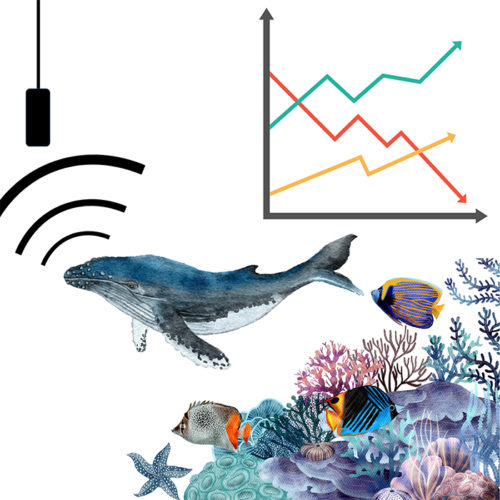
Goals and objectives
- Establish common practices, analytical recommendations, and data standards for underwater soundscapes as applied to biodiversity monitoring and conservation.
- Provide a collaborative space for individuals and organizations working with bioacoustic soundscape data to share methods and participate in coordinated research.
- Produce comparable acoustic data products from NOAA IOOS regional networks (e.g. SECOORA), MBON, and MBON-related regions.
- Advance the language and applications of Essential Ocean Variables, including the Ocean Sound EOV.
- Assess multiple datasets across variable ocean and coastal environments to identify soundscape metric standards.
- Obtain consensus on data storage and metadata practices and share this approach with the broader acoustic community.
- Determine capabilities and limitations of soundscape variables in biodiversity and ecosystem monitoring.
- Collaboratively participate in grant opportunities and publications.
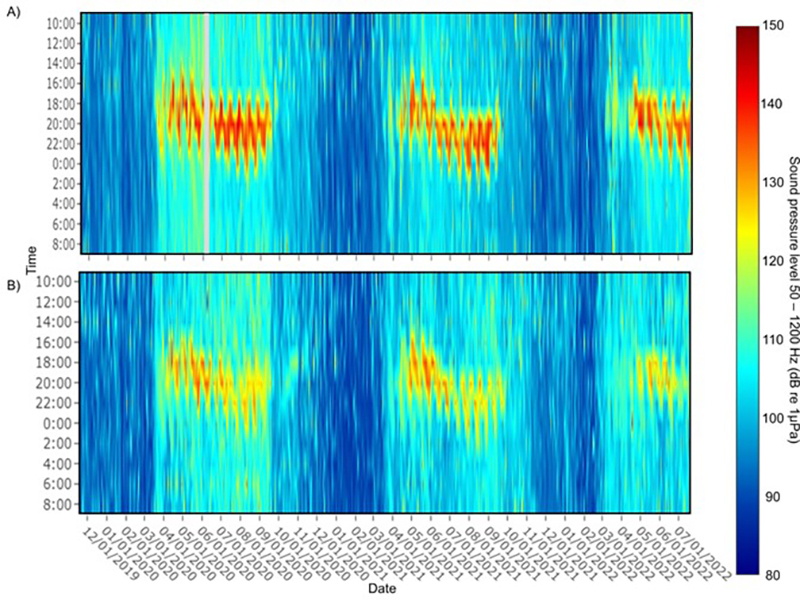
Figure 1. Temporal trends in received low frequency (50–1200 Hz) rms sound pressure levels (SPL) measured hourly in A) Chechessee Creek and B) Colleton River, South Carolina, USA, November 2019–July 2022. (E. Montie, unpublished data)
BioSound products
Data Explorer of Acoustic-Based Marine Biodiversity Indices — an exploratory analysis evaluating trends in soundscape biodiversity metrics across different ocean environments, presented as interactive figures.
Frequently asked questions
Who is leading this project?
This is a collaborative initiative under MBON/IOOS. Project leads are Liz Ferguson (Ocean Science Analytics) and Dr. Neil Hammerschlag (Shark Research Foundation Inc.). Core participants include Eric Montie (University of South Carolina Beaufort), Kate Stafford (Oregon State University), and Jennifer Dorton (SECOORA).
What is required for participation?
Those with passive acoustic data are asked to contribute to analysis efforts. Participants without data should have a background in bioacoustics or marine biodiversity as it relates to sound.
How do I become a collaborator?
Contact working group co-lead Dr. Neil Hammerschlag (neilhammerschlag@gmail.com ) or Liz Ferguson (eferguson@oceanscienceanalytics.com ).
Acoustics
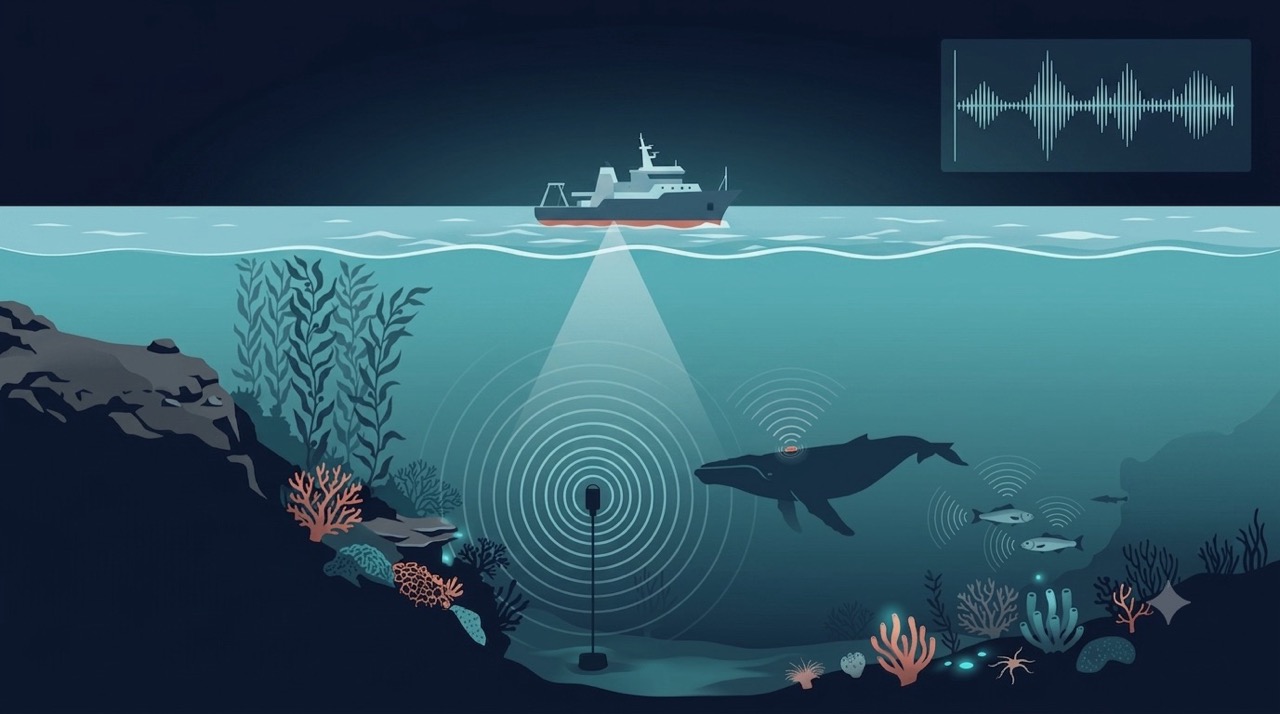
Passive acoustic monitoring listens to the soundscape of the sea; active acoustics enumerates fish and zooplankton. Together they cover the water column continuously, day and night.
Learn more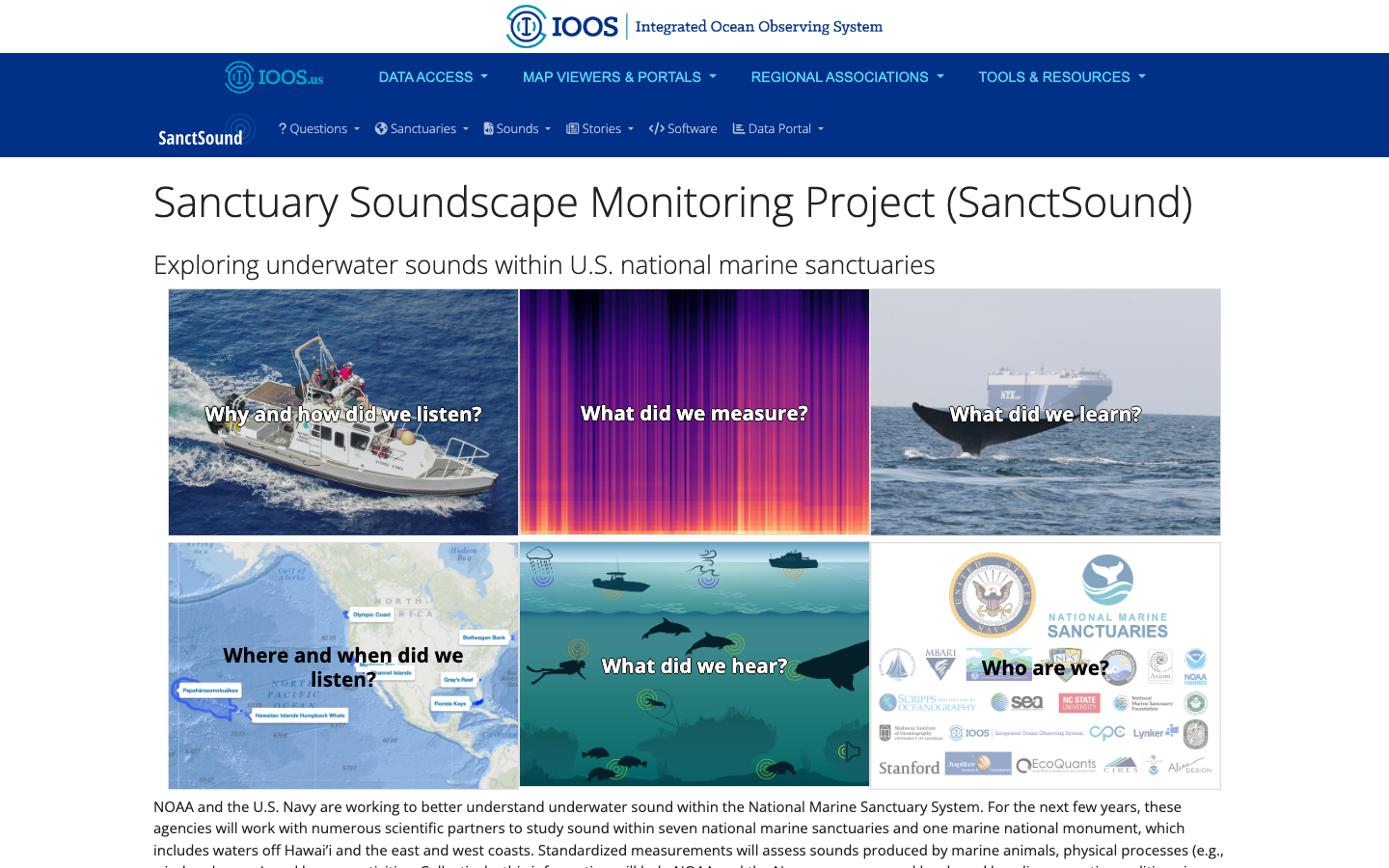
SanctSound
Sanctuary Soundscape Monitoring Project — explore underwater sound across U.S. national marine sanctuaries through illustrated question-and-answer panels.
Learn moreLA MBON Louisiana Oyster Reef-Associated Benthic Biodiversity - Biodiversity Information
This dataset contains abundance and biomass measurements of oyster-reef associated benthic biodiversity as well as extended measures of oyster reef health including sediment organic matter content, volume of reef material, volume and/or counts of live oysters,…
View datasetLA MBON Louisiana Oyster Reef-Associated Benthic Biodiversity - Oyster Sizes
This dataset contains abundance and biomass measurements of oyster-reef associated benthic biodiversity as well as extended measures of oyster reef health including sediment organic matter content, volume of reef material, volume and/or counts of live oysters,…
View datasetUNH - Coastal New England MBON - Atlantic cod
This is the OBIS extraction of the Atlantic Cooperative Telemetry and University of New Hampshire (UNH) UNH - Coastal New England MBON - Atlantic cod, consisting of the release tagging metadata, i.e.
View datasetBioSound Working Group
BioSound working group session on estimating marine biodiversity with passive acoustic monitoring.
View details