
Traditional At-Sea Surveys
Trawl surveys, visual transects, and ship-based acoustic surveys remain the calibration backbone of marine biodiversity monitoring — the gold standard that modern methods are validated against.
Traditional survey methods — bottom trawls, midwater trawls, visual transects by divers or remotely operated vehicles, and ship-based hydroacoustic surveys — have been the primary source of marine biodiversity data for decades. They provide directly observed species identifications, abundance counts, and size measurements that form the calibration baseline for all newer approaches.
Why traditional methods matter
No satellite image or water-column DNA sample yet replaces the taxonomic resolution, ecological context, and direct biological measurement that a skilled observer or net tow can provide. Long-running trawl survey time series are irreplaceable for detecting change, because they span decades with consistent methodology.
The cost problem
The fundamental limitation of ship-based surveys is scale. A research cruise covers a finite geographic area over a finite window of time at significant cost per sample. MBON’s strategic investment in genomics, acoustics, and remote sensing is explicitly motivated by the need to extend coverage between cruises — not to replace them.
Integration with modern methods
MBON uses traditional survey stations as calibration points for:
- eDNA — comparing metabarcoding species lists against trawl catches at the same station
- Active acoustics — groundtruthing echosounder biomass estimates with trawl-confirmed species
- Remote sensing — linking satellite-derived chlorophyll and habitat maps to observed species assemblages
This integration allows the network to extrapolate from point observations to basin-scale understanding.
More ways MBON observes
Satellites and aerial sensors resolve ocean color, temperature, and habitat extent across millions of square kilometers — scales no ship survey can match.
Passive acoustic monitoring listens to the soundscape of the sea; active acoustics enumerates fish and zooplankton. Together they cover the water column continuously, day and night.
Electronic tags on fish, turtles, marine mammals, and seabirds reveal how animals move through and use ocean habitat — essential for conservation planning and understanding climate responses.
Environmental DNA extracted from water and sediment samples reveals the full community of organisms present — from bacteria to whales — with a speed and breadth impossible through visual surveys alone.
Raw observations become decision-relevant information through synthesis into Essential Ocean Variables, open data pipelines, and indicators that managers and policymakers can act on.
Rocky-shore and sandy-beach transects, photo quadrats, and intertidal surveys record coastal biodiversity — connecting the land-sea interface to the global observation network.
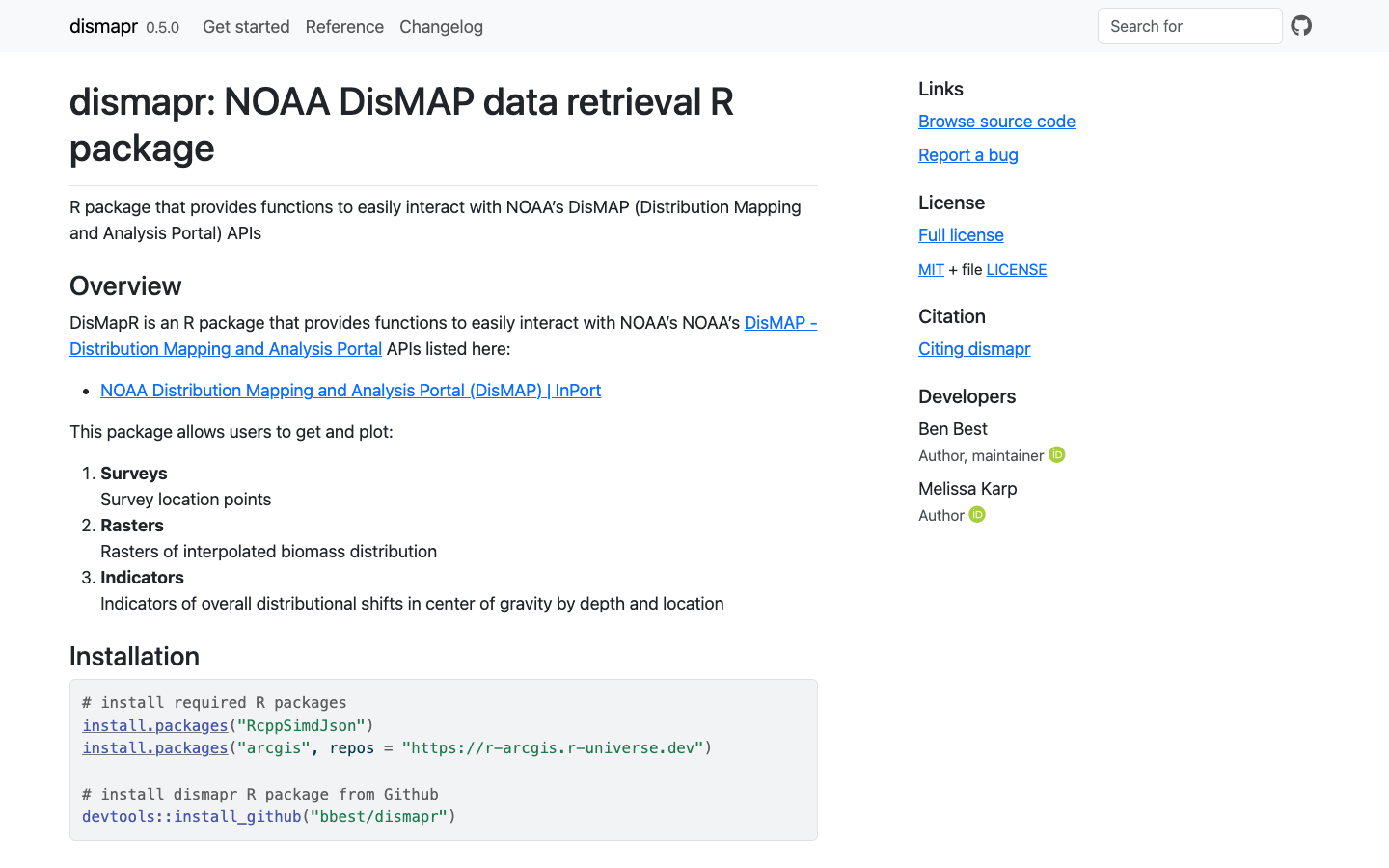
dismapr
R package with functions to interact with NOAA's Distribution Mapping and Analysis Portal (DisMAP) APIs for species distribution and range-shift data.
Learn moreTime series of zooplankton abundance in the Florida Keys, collected by the South Florida Program (NOAA/AOML) and the Marine Biodiversity Observation Network (MBON)
Sampling is carried out bi-monthly on the R/V Walton Smith (University of Miami) as part of the South Florida Program (NOAA Atlantic Oceanographic and Meteorological Laboratory/ AOML) and the Marine Biodiversity Observation Network (MBON).
View datasetBenthic Epifauna Biomass and Abundance Data, Arctic Marine Biodiversity Observing Network (AMBON) research cruise on the Norseman II, 9 August 2015 - 3 September 2015
This dataset contains benthic epifauna biomass and abundance data collected in the Chukchi Sea, U.S. Arctic during the 9 August - 3 September 2015 Arctic Marine Biodiversity Observing Network (AMBON) research cruise aboard the vessel Norseman II.
View datasetBenthic Epifauna Biomass and Abundance Data, Arctic Marine Biodiversity Observing Network (AMBON) research cruise, August 2017
Marine biodiversity is a key component of ocean health. Monitoring and understanding marine biodiversity is essential for our ability to forecast and respond to changes.
View datasetFish length, weight, and abundance data from trawl surveys in the Chukchi Sea, Arctic Marine Biodiversity Observing Network (AMBON) research cruise on the vessel Norseman II, 09 August 2015 - 03 September 2015
This dataset is three comma-separated values (csv) files containing fish haul information collected during trawl surveys in the Chukchi Sea during the 9 August - 3 September 2015 Arctic Marine Biodiversity Observing Network (AMBON) research cruise.
View datasetMarine Bird Sighting Data, Arctic Marine Biodiversity Observing Network (AMBON) Chukchi Sea research cruise on the vessel Norseman II from 2015-08-09 to 2015-09-03
This dataset contains seabird survey and associated environmental conditions data collected in the Chukchi Sea during the 9 August - 3 September 2015 Arctic Marine Biodiversity Observing Network (AMBON) research cruise.
View dataset